
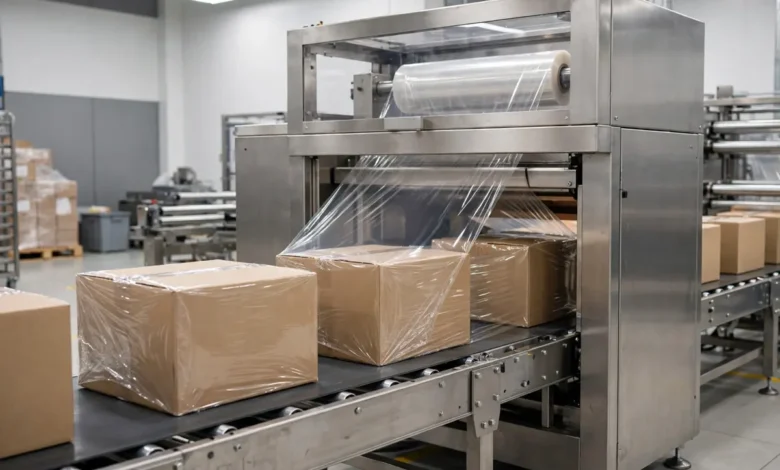

Shrink packaging is widely used because it can protect products, improve presentation, reduce handling issues, and support efficient distribution. But the film itself is only one part of the process. Sealing quality, heat control, conveyor speed, product spacing, airflow, and line integration all influence the consistency of the finished package.
For manufacturers and fulfillment operations, polyeolefin shrink equipment can be particularly useful when packaging needs to move beyond manual wrapping and into a repeatable production process. The right combination of sealers, shrink tunnels, conveyors, and peripheral equipment can improve throughput while reducing unnecessary handling between stages.
Why Polyolefin Film Is Common in Shrink Packaging
Polyolefin, commonly abbreviated as POF, is used for many shrink-wrapping applications because it can produce a clear, durable package around a wide variety of products.
It is often selected when presentation matters as well as protection. Depending on the film specification and equipment setup, it may be used for consumer goods, printed products, boxed items, multipacks, and other retail-ready packages.
The performance of polyeolefin shrink equipment depends on matching the film to the product, sealing system, and shrink tunnel.
Film thickness, product dimensions, sealing temperature, tunnel temperature, and conveyor speed all need to work together to produce consistent results.
The Sealer Starts the Packaging Cycle
Before film can shrink around a product, it normally needs to be sealed.
L-sealers are commonly used to create sealed film around individual products or grouped items. Depending on production requirements, these systems may operate manually, semi-automatically, or automatically.
Higher-volume lines can also use side-sealing systems for continuous or intermittent packaging.
Current shrink-equipment ranges include both L-sealers and side sealers, along with separate heat tunnels and peripheral equipment designed for broader line integration.
When comparing polyeolefin shrink equipment, the appropriate sealer should be chosen according to product dimensions, desired throughput, film type, and how products arrive at the packaging station.
Heat Tunnels Determine the Final Shrink
After sealing, the package enters a heat tunnel.
The tunnel exposes the film to controlled heat so it contracts around the product. Air temperature, airflow pattern, conveyor speed, tunnel dimensions, and film characteristics all affect the final appearance.
Too little heat or insufficient dwell time can leave loose areas. Excessive heat may distort the film or affect heat-sensitive products.
Some modern shrink tunnels are designed to switch between polyethylene and POF applications and can be integrated with inline conveyors for continuous operation.
This makes tunnel configuration one of the most important parts of a polyeolefin shrink equipment setup.
Conveyor Speed Has to Match the Entire Line
A packaging line only operates efficiently when individual machines are synchronized.
If a sealer produces packages faster than the tunnel can process them, products may accumulate between stages. If the discharge conveyor moves too slowly, it can create a bottleneck even when the sealing and shrinking systems are capable of higher throughput.
Conveyors can help regulate:
- Product spacing
- Transfer between machines
- Tunnel dwell time
- Discharge flow
- Operator handling
- Downstream accumulation
This is why peripheral equipment should not be treated as an afterthought.
In many operations, the efficiency of polyeolefin shrink equipment depends just as much on material movement as it does on sealing or heating.
Peripheral Equipment Can Reduce Manual Handling
Packaging lines often require more than a sealer and tunnel.
Products may need to be aligned, grouped, rotated, labeled, coded, or transferred before and after shrink wrapping. Peripheral systems can automate some of these steps.
Current industrial shrink-packaging systems may incorporate custom infeed and discharge automation for tasks such as automatic feeding, grouping, paper insertion, aligning, rotating, labeling, and coding.
Reducing unnecessary manual movement can improve consistency and may allow operators to focus on inspection, replenishment, or exception handling rather than repeatedly repositioning products.
Product Dimensions Influence Machine Selection
One of the most basic equipment-selection mistakes is focusing only on production speed.
The machine must first be capable of handling the actual product.
Important measurements include:
- Product length
- Width
- Height
- Weight
- Orientation
- Film width
- Package configuration
A system designed for relatively flat cartons may not be appropriate for tall, irregular, or unstable products.
When specifying polyeolefin shrink equipment, companies should consider their largest and smallest expected packages rather than designing the line around only one average product size.
Future product changes should also be considered where possible.
Film Choice Affects Equipment Settings
Different films do not behave identically when exposed to heat.
POF film characteristics can vary according to gauge, formulation, shrink force, and intended application. Machine settings therefore need to be adjusted accordingly.
Sealing temperature affects whether seams are secure without damaging the material. Tunnel temperature and airflow affect how evenly the film shrinks around corners and surfaces.
Operators should avoid treating one set of parameters as universally correct for every product.
A properly configured polyeolefin shrink equipment line should allow settings to be adjusted when film specifications or package dimensions change.
Automation Should Match Production Volume
Full automation is not automatically the best choice for every operation.
Lower-volume businesses may benefit from semi-automatic equipment because it provides improved consistency without requiring a complex line. Higher-volume production environments may gain more from automatic feeding, sealing, shrinking, and discharge.
The correct level of automation depends on factors such as:
- Packages per minute
- Number of SKUs
- Product variation
- Labor availability
- Shift length
- Changeover frequency
- Available floor space
Automation provides the greatest value when it removes an actual production constraint.
Buying more complicated equipment than necessary can increase training and maintenance requirements without creating proportional productivity gains.
Changeover Time Can Affect Real Throughput
Maximum machine speed does not always represent real production performance.
A line may run quickly once configured but lose significant time if operators frequently change film rolls, product sizes, guides, conveyor settings, or tunnel parameters.
For businesses packaging many SKUs, easy changeovers can therefore be more important than the highest theoretical speed.
When evaluating polyeolefin shrink equipment, companies should consider how often settings will change during a typical shift.
Simple adjustment points, stored settings, and accessible controls can help reduce downtime between products.
Energy Efficiency Matters in Heat Shrinking
Shrink tunnels use heat continuously during operation, making energy consumption a meaningful operating consideration.
Insulation can help retain heat inside the tunnel rather than allowing it to escape into the surrounding workspace. Some current industrial tunnel designs use double-layer insulation specifically to improve heat retention and reduce energy consumption.
Equipment should also be sized appropriately.
Running a tunnel substantially larger than necessary for small products may increase energy use without improving packaging performance.
Temperature control and planned shutdown procedures can further influence operating efficiency.
Maintenance Should Be Part of Equipment Planning
Packaging machinery operates most reliably when maintenance is planned from the beginning.
Common areas requiring attention may include conveyor belts, heaters, sealing components, temperature sensors, moving parts, and electrical systems.
Operators should be trained to identify early warning signs such as inconsistent seals, unusual conveyor movement, uneven shrinking, or unexpected temperature changes.
Access to technical support and replacement parts can also affect downtime. Industrial packaging suppliers may maintain dedicated service and parts operations to support installed systems.
For high-volume operations, serviceability can be almost as important as initial machine performance.
Think About the Entire Packaging Workflow
The best shrink-wrap system should not be evaluated in isolation.
Consider where products come from before sealing and where they go after shrinking. A fast packaging machine provides limited benefit if employees still have to manually carry products from another workstation or if finished packages immediately accumulate downstream.
The complete workflow may include:
- Product preparation
- Infeed
- Film wrapping
- Sealing
- Heat shrinking
- Cooling
- Inspection
- Labeling
- Case packing or distribution
A well-designed polyeolefin shrink equipment configuration should help these stages work as one connected process.
Conclusion
Efficient shrink packaging depends on much more than putting film around a product. Seal quality, tunnel performance, conveyor speed, product handling, equipment sizing, energy use, and changeover requirements all influence how well a line performs. For businesses evaluating polyeolefin shrink equipment, the strongest approach is to design around real package dimensions, production volumes, film specifications, workflow constraints, and expected future needs. Equipment portfolios from Maripak USA demonstrate how sealers, heat tunnels, conveyors, and custom peripheral systems can be combined to support different levels of industrial shrink-packaging automation. When all stages of the packaging process are properly matched, manufacturers can create a more consistent flow from product infeed to finished package while reducing avoidable handling and production bottlenecks.
Related Guides
- Bestpack Packaging Systems: Maintenance Tips for Reliable Output
- How Automatic Side Sealing Machines Improve Modern Packaging Efficiency
- Belco B-2748: Understanding Packaging Equipment Maintenance and Performance
- Belco Tunnel Components and Conveyor Belt Specifications for STC2016 Systems
- Custom Food Pouches: Smart and Safe Packaging
Related Reading
For a look at a classic product with a long heritage, our guide Jameson Irish Whiskey: A Complete Guide to Ireland’s Famous Whiskey explores Ireland’s famous whiskey in detail.
On the manufacturing side, 5 Axis Vertical Machining Center: Applications and Manufacturing Advantages explains where advanced machining delivers the most value.
And for readers planning a celebration, Wedding Bar Catering Service: Beverage Catering Elevates Wedding Celebrations shows how beverage catering can lift an event.
Related Reading
For practical outdoor storage ideas, see 10 x 7.5 Utility Storage Unit: A Full-Scale Outdoor Equipment Room for a full-scale outdoor equipment room.
Shops also stock up on consumables — our rubber abrasive wheel guide covers types, grits and typical uses.
For hand-finishing work, see why hand-stitched rasps are preferred by woodworkers for shaping and smoothing.