

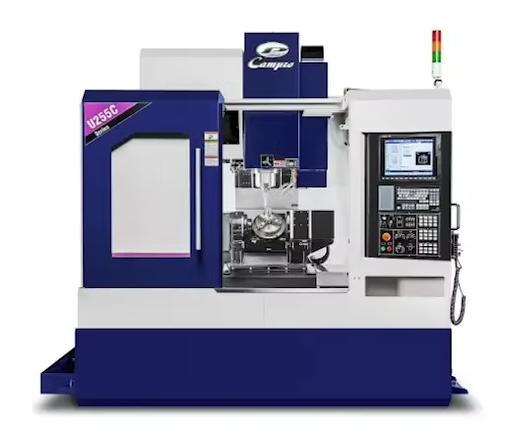
Modern manufacturing demands precision, efficiency, and the ability to produce increasingly complex components. Industries such as aerospace, automotive, medical device manufacturing, energy production, and precision engineering require machining solutions that can handle intricate geometries while maintaining tight tolerances. This is where a 5 axis vertical machining center has become an essential part of advanced manufacturing operations.
Unlike traditional machining systems that operate on three linear axes, 5-axis technology allows simultaneous movement across multiple axes, enabling manufacturers to machine complex parts in fewer setups. The result is improved accuracy, faster production cycles, and enhanced overall productivity. As manufacturers continue to seek ways to increase efficiency and reduce production costs, the demand for advanced machining technology continues to grow.
What Is a 5 Axis Vertical Machining Center?
A 5 axis vertical machining center is a CNC machine that operates along three linear axes—X, Y, and Z—while incorporating two additional rotational axes.
These additional axes allow the cutting tool or workpiece to move and rotate during machining operations, enabling access to multiple surfaces without repositioning the part manually.
Key capabilities include:
- Simultaneous multi-axis machining
- Complex contour creation
- Reduced setup requirements
- Improved surface finishes
- Enhanced dimensional accuracy
This advanced functionality allows manufacturers to produce highly detailed components that would be difficult or impossible to create using conventional machining methods.
How 5-Axis Machining Works
Traditional machining often requires multiple setups to access different sides of a workpiece.
With a 5 axis vertical machining center, the machine can reposition the cutting tool and workpiece automatically during operation.
This capability allows manufacturers to:
- Machine multiple surfaces in a single setup
- Reduce human intervention
- Improve consistency
- Minimize alignment errors
By eliminating repeated repositioning, manufacturers can achieve higher precision while reducing overall production time.
Advantages of 5 Axis Vertical Machining Centers
Improved Accuracy
One of the most significant benefits of 5-axis machining is increased accuracy.
Since parts remain secured in a single setup for most operations, there is less opportunity for positioning errors that can occur during multiple setups.
This level of precision is particularly important for industries requiring extremely tight tolerances.
Reduced Production Time
A 5 axis vertical machining center can complete complex operations faster than traditional machining systems.
Benefits include:
- Fewer setups
- Reduced handling time
- Shorter cycle times
- Improved workflow efficiency
These advantages help manufacturers increase output while maintaining product quality.
Enhanced Surface Finish
Because cutting tools can approach the workpiece from optimal angles, machining marks are often reduced.
This results in:
- Smoother surfaces
- Less secondary finishing
- Improved component quality
Enhanced surface finishes are especially valuable in aerospace, medical, and high-performance engineering applications.
Greater Design Flexibility
Modern products often contain complex geometries and intricate features.
5-axis machining enables manufacturers to produce:
- Curved surfaces
- Deep cavities
- Complex contours
- Detailed shapes
Design engineers can create more sophisticated components without being limited by traditional machining constraints.
Industries That Use 5-Axis Machining
Aerospace Manufacturing
Aerospace components frequently require intricate geometries and extremely tight tolerances.
Common applications include:
- Turbine components
- Structural brackets
- Engine parts
- Airframe components
Medical Device Manufacturing
Medical manufacturers rely on precision machining for products such as:
- Surgical instruments
- Orthopedic implants
- Medical equipment components
Automotive Production
The automotive industry uses advanced machining technology to manufacture:
- Engine components
- Transmission parts
- Performance components
- Prototype parts
Energy and Industrial Equipment
Many energy-sector components require precise machining to ensure reliability and performance under demanding operating conditions.
Key Features to Consider
When evaluating a 5 axis vertical machining center, manufacturers often consider several important factors.
Spindle Performance
High-performance spindles support faster cutting speeds and improved productivity.
Work Envelope
The machine’s travel dimensions determine the size of components it can accommodate.
Control Systems
Advanced CNC controls improve programming efficiency and machining accuracy.
Automation Capabilities
Automation features can reduce labor requirements and increase production consistency.
Many manufacturers also compare machine rigidity, thermal stability, and tool-changing capabilities when selecting machining equipment.
Productivity Benefits for Manufacturers
Advanced machining technology provides several operational advantages.
Reduced Labor Requirements
Fewer setups mean less manual intervention throughout the manufacturing process.
Improved Tool Life
Optimal cutting angles often reduce tool wear.
Faster Lead Times
Manufacturers can produce parts more quickly while maintaining high quality standards.
Lower Operating Costs
Improved efficiency often contributes to reduced production expenses over time.
Many modern facilities integrate a CNC vertical machining center alongside 5-axis systems to create flexible manufacturing environments capable of handling a broad range of production requirements.
The Role of Advanced CNC Technology
The evolution of CNC machining continues to transform manufacturing capabilities.
Today’s machining centers incorporate:
- Advanced software integration
- High-speed machining capabilities
- Automated tool management
- Precision motion control systems
- Real-time monitoring technologies
These innovations help manufacturers improve productivity while maintaining exceptional quality standards.
As global competition increases, companies continue investing in advanced machining technologies to remain competitive and meet growing customer expectations.
Future Trends in Precision Manufacturing
Manufacturing technology continues to evolve through increased automation, digital integration, and advanced machining strategies.
Emerging trends include:
- Smart factory integration
- Predictive maintenance systems
- Artificial intelligence-assisted machining
- Enhanced automation solutions
- Improved machine connectivity
These developments are helping manufacturers optimize production processes while reducing downtime and operational inefficiencies.
Conclusion
A 5 axis vertical machining center has become an essential tool for manufacturers seeking greater precision, efficiency, and flexibility. By enabling complex machining operations in fewer setups, these advanced systems help improve accuracy, reduce production time, and support the creation of highly sophisticated components. As manufacturing demands continue to evolve, businesses investing in advanced machining solutions can strengthen their competitive position, improve operational efficiency, and expand production capabilities through CNC machines in USA. Industries ranging from aerospace and automotive to medical device manufacturing continue to benefit from the capabilities offered by modern 5-axis technology.