
Dopamine Menu vs. Time Blocking: How to Manage Multiple 3,000-Word Essay Deadlines Simultaneously

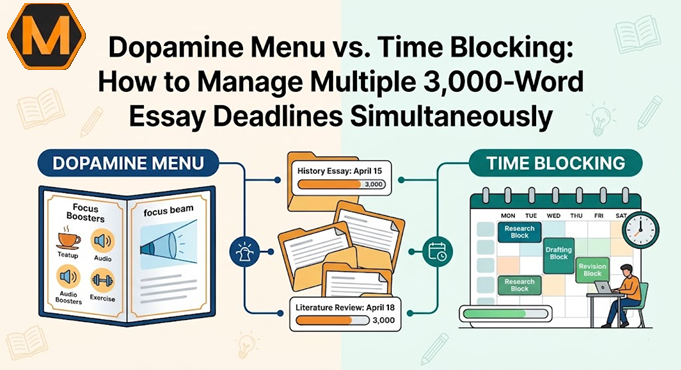
A dopamine menu may sound like a small trick, but paired with time blocking it can change how a heavy writing week feels. This guide shows how a dopamine menu of short, healthy rewards can sit inside a realistic schedule for several long essays at once.
Striking a balance between a massive university workload and your sanity often feels like a losing battle. When you look at your calendar and see three different 3,000-word essay deadlines all landing in the same week, panic is a completely normal reaction. A long-form academic paper isn’t something you can just pull off in a single caffeine-fueled night; it requires deep research, tight structuring, and clear editing. The sheer volume of reading, drafting, and formatting can easily paralyze your progress before you even type your first sentence.
When you find yourself staring at a completely blank screen, the hardest part is simply figuring out how to begin. If the pressure of managing multiple deadlines becomes too overwhelming, some students choose to purchase essay online through myassignmenthelp to see high-quality structural examples and ease their immediate stress. However, if you want to tackle these massive writing projects yourself, you need a reliable strategy to organize your thoughts and protect your mental energy. The true secret to academic survival lies in moving away from chaotic cramming sessions and embracing structured, predictable writing workflows.
Two popular productivity methods have emerged to help people get things done: Time Blocking and the Dopamine Menu. While they approach work from completely different angles, combining them gives you a powerful system to handle heavy academic writing without burning out. By understanding how to manage both your calendar and your neurological energy, you can systematically dismantle massive assignments and maintain peak performance throughout the entire semester.
The Reality of the 3,000-Word Essay
Before diving into the scheduling strategies, it helps to break down what a 3,000-word essay actually demands. It is helpful to visualize this massive task as a modular building project rather than one overwhelming mountain of text. When an assignment seems too big to wrap your head around, breaking it down into standardized structural blocks makes it feel achievable.
[3,000-Word Essay Blueprint]
├── Introduction & Thesis Statement (~300 words)
├── Background & Literature Review (~600 words)
├── Core Arguments & Evidence (~1,200 words)
├── Counterarguments & Refutations (~600 words)
├── Conclusion & Future Outlook (~300 words)
When you have three of these due at once, you aren’t trying to write 9,000 words in one go. Instead, you are managing a series of smaller, independent writing tasks. The trick to surviving this is separating your writing days from your research days so your brain doesn’t get tired from constantly switching gears. When you understand the anatomy of a long-form paper, you can target specific sections during your peak energy hours.
Strategy 1: Time Blocking for Deep Research
Time blocking is a classic productivity method where you divide your day into dedicated chunks of time. Each block is assigned to one specific task, and one task only. Instead of writing down a vague goal like “work on history paper today,” your calendar shows a clear plan: 9:00 AM to 11:00 AM: Source 4 Peer-Reviewed Articles for History Essay. This eliminates decision fatigue because you never have to sit at your desk wondering what to do next.
This approach works incredibly well for the heavy research phase of an essay. Research requires deep concentration, and every time you stop to check your phone or look at a notification, it takes your brain an average of 23 minutes to regain full focus. By blocking out two-hour windows dedicated entirely to gathering data, you can build a strong foundation for your paper much faster.
For essay-heavy majors, a successful time-blocking schedule might look like this:
- Block 1 (Morning): Heavy research and building detailed outlines while your mind is completely fresh and free from daily distractions.
- Block 2 (Early Afternoon): Drafting rough paragraphs without worrying about perfect grammar, style, or spelling.
- Block 3 (Late Afternoon): Cleaning up citations, checking bibliographies, or using a professional essay editing service to polish your tone and flow.
The Weekly Time-Blocking Matrix
To keep track of multiple deadlines without overlapping your focus, you need a visual map of your week. The matrix below shows how to distribute tasks evenly across three different essay assignments:
| Day | Morning Block (09:00 – 12:00) | Afternoon Block (13:00 – 16:00) | Evening Block (17:00 – 19:00) |
| Monday | Essay 1: Sourcing Literature | Essay 1: Structural Outlining | Admin: Citation Setup & Library Runs |
| Tuesday | Essay 2: Sourcing Literature | Essay 2: Structural Outlining | Admin: Digital Folder Organization |
| Wednesday | Essay 3: Sourcing Literature | Essay 3: Structural Outlining | Admin: Source Verification |
| Thursday | Essay 1: Drafting Core Arguments | Essay 1: Drafting Counterarguments | Essay 1: Initial Proofreading |
| Friday | Essay 2: Drafting Core Arguments | Essay 2: Drafting Counterarguments | Essay 2: Initial Proofreading |
| Saturday | Essay 3: Drafting Core Arguments | Essay 3: Drafting Counterarguments | Essay 3: Initial Proofreading |
| Sunday | Final Polishing: All Essays | Buffer Block (Catch-up Time) | Total Relaxation & System Reset |
Strategy 2: The Dopamine Menu for Sustained Focus
While time blocking is great on paper, it has a major weakness: it assumes you will always have the willpower to follow your schedule. When you are dealing with heavy college stress, your brain often craves immediate distraction rather than deep focus. This is where a dopamine menu comes in.
A dopamine menu is a curated list of healthy, intentional rewards that give your brain a quick energy boost without completely derailing your workday. Instead of scrolling mindlessly through social media for an hour, you choose a quick, pre-planned activity to refresh your focus. It acts as an emergency toolkit for your brain when executive dysfunction kicks in and words stop making sense.
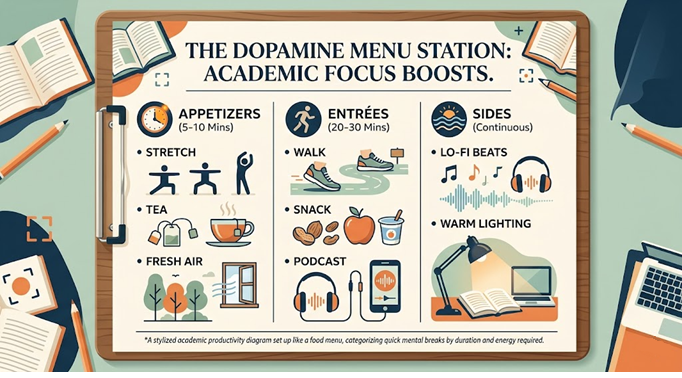
To make this strategy work, divide your menu into different categories based on how much time and energy you have available:
- Appetizers (5-10 Minutes): Do a quick stretching routine, make a fresh cup of tea, or step outside for some fresh air.
- Entrées (20-30 Minutes): Take a short walk around the block, eat a healthy snack, or listen to a favorite podcast episode.
- Desserts (End of the Day): Watch a movie, spend time with friends, or play a video game after your daily writing goals are met.
- Sides (Passive Boosts): Play low-fidelity beats in the background, light a scented candle, or work under soft, warm lighting.
When you feel your concentration slipping mid-essay, pick something from your appetizers list. This satisfies your brain’s need for a break while making it much easier to jump back into writing without losing your momentum.
Combining Both Systems to Beat Deadlines
To successfully manage multiple deadlines simultaneously, you can use time blocking to structure your day and the dopamine menu to fuel your focus during those blocks. The two systems work hand-in-hand: time blocking builds the walls, and the dopamine menu keeps the lights on inside.
The secret is to alternate your focus between your different papers. Working on the exact same topic for eight hours straight usually leads to writer’s block. By shifting to a different essay subject after a long break, you keep your mind engaged and prevent creative fatigue.
1.The Outline Phase:Days 1-2.
Create detailed outlines for all three essays. Identify your core thesis statements and list the specific evidence or data points you need to find for each argument before you begin typing paragraphs.
2.The Targeted Research Blocks:Days 3-5.
Use morning time blocks to gather your research materials. Keep your notes organized by essay topic in separate digital folders so you don’t mix up your source materials later on.
3.The Modular Drafting Phase:Days 6-9.
Write your papers in small, 500-word blocks. Use your dopamine menu rewards between writing sessions to keep your energy levels consistent and avoid mental burnout.
4.The Final Polish:Days 10-12.
Dedicate your final blocks entirely to proofreading, checking your style alignment, and making sure your citations match the required academic format perfectly.
Balancing Your Daily Workload
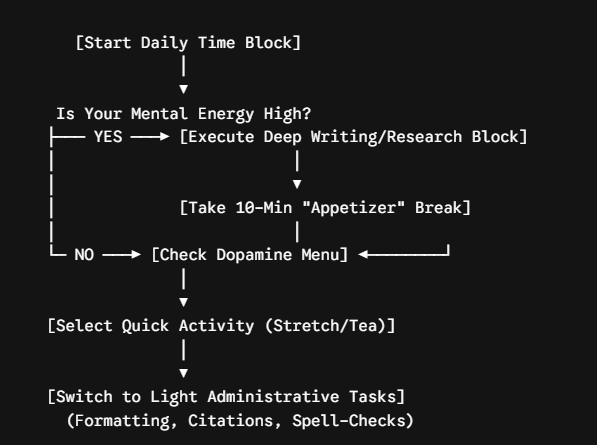
When executing this combined strategy, it is critical to balance your cognitive load across the day. The flowchart below shows how to navigate your daily schedule depending on your real-time mental energy levels:
Advanced Editing Tactics for Long-Form Papers
Once your rough drafts are finished, the real work begins. A 3,000-word essay cannot simply be turned in after a single spelling check. To secure top marks, you must audit your writing for structural integrity and logical flow.
The Paragraph Integrity Test
Every single paragraph in your academic essay should act as a miniature argument. You can test the strength of your prose by checking if each paragraph contains the following four elements:
- Topic Sentence: A clear claim that connects directly back to your primary thesis statement.
- Evidence: A direct quote, data point, or paraphrase from a reliable peer-reviewed source.
- Analysis: Your original explanation of why this evidence matters and how it proves your claim.
- Transition: A closing thought that connects this paragraph smoothly to the upcoming section.
If you find paragraphs that are over 300 words long, they are likely trying to make too many points at once. Break them down at the transition points to keep your text highly readable for your professors.
Final Thoughts for Success
Surviving a heavy college semester isn’t about working until you drop; it is about managing your time and your energy intelligently. Time blocking gives your week the structure it needs to stay on track, while a dopamine menu protects your mental health along the way.
By breaking your 3,000-word assignments down into smaller, bite-sized pieces and pairing steady work with deliberate rest, you can easily meet your deadlines, protect your peace of mind, and turn in work you are proud of. Academic success is a marathon, not a sprint, and with the right systems in place, no deadline is too large to conquer.
Frequently Asked Questions
How do I prevent my essay topics from getting mixed up?
Dedicate separate days or distinct morning and afternoon slots to each subject. Never work on two different papers within the same time block, and keep separate digital folders for each project’s research sources.
What should I do if I get writer’s block during a scheduled block?
Switch to light administrative tasks like formatting your bibliography, organizing references, or proofreading sections you already wrote. This keeps you productive without forcing creative output when your brain is tired.
How long should an appetizer break last?
Keep these quick energy boosts to between 5 and 10 minutes. This is just enough time to step away from your desk, stretch, or grab water without losing your momentum or entering a state of total distraction.
Is it better to write or research first when handling multiple deadlines?
Always gather your research and build detailed structural outlines for all your papers before you start drafting paragraphs. Having your data fully organized makes the actual writing phase much faster and easier.
About The Author
Ruby Walker is an educator and learning strategist at myassignmenthelp, where she designs practical workflow models and high-performance study frameworks to help university students balance heavy research workloads with executive function